
Why Hemp?

Brooke wears the Capo Blazer and Capo Trousers, made of 100% organic hemp.
Growing hemp is good for the planet.
Imagine for a moment that farming crops is like hosting a dinner party. Cotton would be the guest who shows up empty-handed, makes a mess, and leaves without saying thank you. Hemp, on the other hand, brings a beautiful homemade candle, makes everyone laugh, and helps clean up after the meal.
From an environmental perspective, hemp has unique characteristics that make it particularly sustainable:
Healthy soil. While many crops (like conventionally grown cotton) cause erosion, hemp returns over half of the nutrients back to the soil, making it naturally regenerative.
Carbon sequestration. As it grows, the hemp plant removes large amounts of carbon from the atmosphere and stores it in the ground through a process called bio-sequestration. One hectare of hemp can absorb 22 tons of CO2—that’s more than a forest. Hemp is a powerful tool for mitigating the effects of climate change.
Resource efficiency. Hemp can flourish in a variety of climates. Compared to cotton, hemp produces twice the amount of fiber on half the amount of land, while using 90% less water.
No toxic inputs. The cannabis sativa plant earned the nickname “weed” because it is fast-growing and naturally resilient. As a result, the use of toxic pesticides and herbicides can be avoided in most cases.
Versatility. Hemp is one of the most versatile plants on Earth—all parts of the plant can be utilized to create thousands of different products from CBD oil to biofuel.
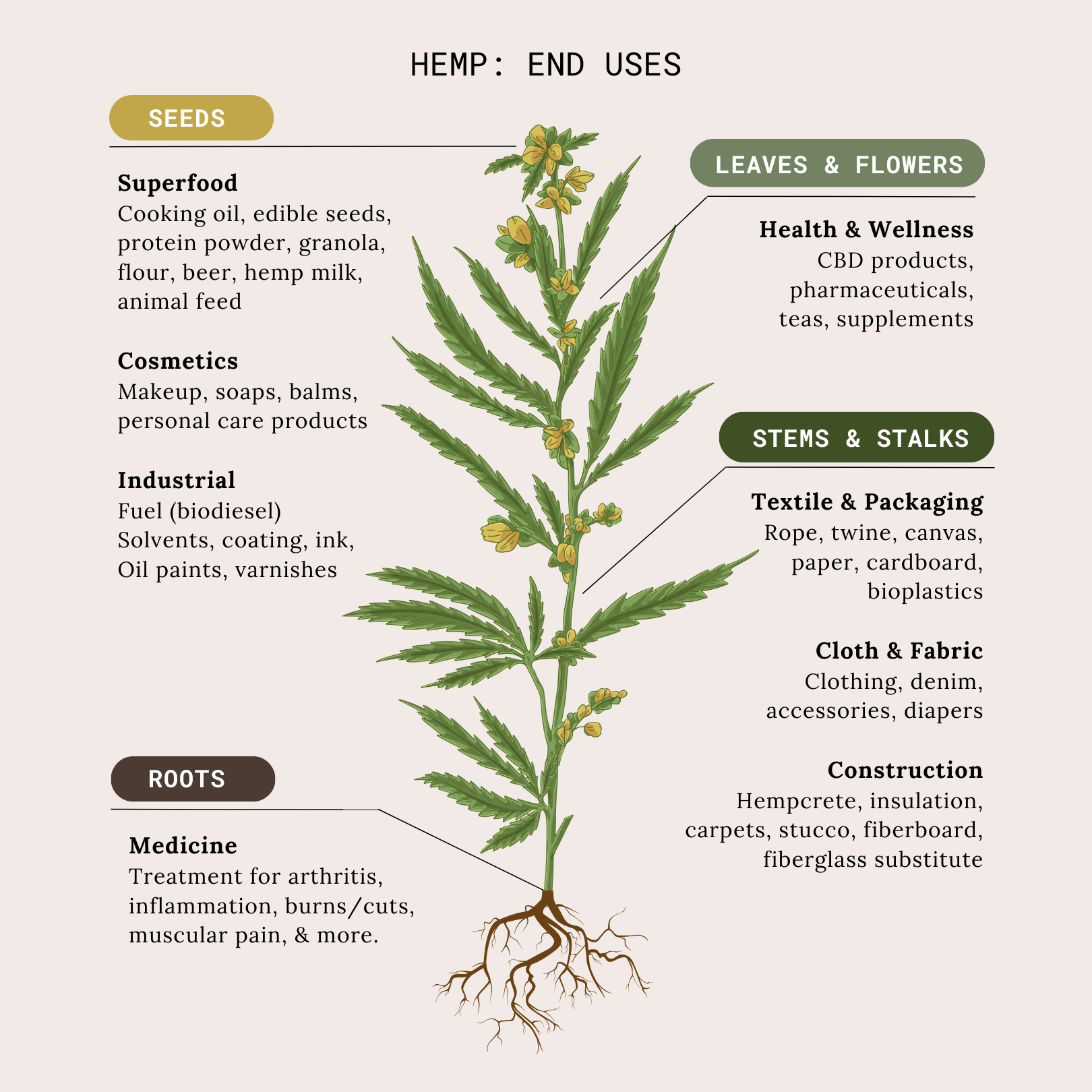
Hemp creates little to no waste since all parts of the plant can be utilized for a diverse range of products.
Wearing hemp is good for people.
Hemp can be woven into textiles of different weights, ranging from light to heavy like upholstery. To the touch, hemp can feel like cotton, linen, or a wool blend, making it an appropriate substitute for conventional fibers.
We prefer to use hemp because it has special properties that make it unique:
Tensile strength. Hemp fabric is four times stronger than cotton and eight times stronger than linen. A garment made out of hemp is built to last a lifetime, and as a result, the cost per wear will be lower than a comparable product made out of cotton or linen.
Antimicrobial. As hemp is naturally antimicrobial, it won’t cling to unpleasant odors the way a synthetic fabric does, and it needs to be washed less.
Stretch and softness. Unlike cotton, hemp does not stretch out, so the form of a garment will remain intact even after it has been worn for long periods. Rather than wear out over time, hemp fabrics become softer (even when they are regularly washed in the machine).
Absorption, insulation, and UV resistance. Hemp is ideal for extreme temperatures. The fabric’s incredible insulation properties will keep the body warm in cold weather. Due to the porous nature of hemp, and its high UV resistance, it is a smart fabric choice for heat as well. The high absorbency of hemp also makes it easier to dye, so color won’t fade as fast as other fabrics.